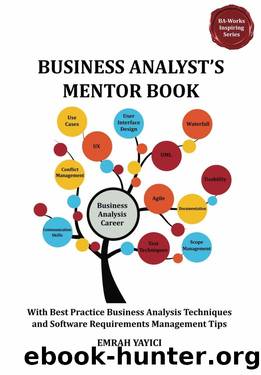
Business Analyst's Mentor Book : With Best Practice Business Analysis Techniques and Software Requirements Management Tips by Emrah Yayici
Author:Emrah Yayici [Yayici, Emrah]
Language: eng
Format: epub
Published: 2013-08-13T07:00:00+00:00
14. How Can Automation Help in Requirements Management?
In recent years, we have started to see a different “ware” category like hard-ware and soft-ware. This category is called “shelf-ware.” Shelf-ware represents the automation software that sits on the shelves of the company without being used by any single person.
Shelf-ware causes a huge amount of sunk cost for IT departments. In some public companies, high license and support costs paid for useless software has become an issue investigated during internal audits.
To prevent the shelf-ware situation, the following best practices should be taken into consideration during automation of the requirements management process:
Tools Are Wizards, but Not Magicians
Some IT managers want to press a button and let the computer automatically do the majority of analysis, design, and testing work instead of utilizing people for these tasks. Unfortunately, this is only a management dream.
Tools are wizards, but not magicians. They have limits. They can only help the project team do their work in a more convenient way by automating some of their tasks, but not all of them.
Think Big but Start Small
If the IT organization’s process maturity is at a good level, automation makes it better; otherwise, automation may even make it worse. Hence IT managers should first focus on improving their team’s requirements management skills and then give the start for the automation initiative.
If the team has no knowledge on basic techniques like use cases, traceability matrices, impact analysis, black box test techniques, and low fidelity prototyping, then automation will only bring extra problems rather than benefits and will accelerate the chaos.
An iterative approach of first implementing these techniques by using simple templates and then adapting the automation tools is the best-proven way of success.
Adam Smith and Software Engineering
Like the manufacturing industry, Adam Smith’s division of labor theory has also gained acceptance in software engineering. By using the new SDLC (systems development life cycle) tools, demand management, project management, business analysis, user interface design, technical design, coding, and testing processes can be managed in integration with each other on a common platform.
Requirements management tools let you receive, prioritize, and plan requests from business units.
Then they guide you in preparation of analysis documents. The requirements defined on these documents are automatically stored in a repository to enable end-to-end traceability.
Analysis and design diagrams like activity diagrams, sequence diagrams, and class diagrams can be prepared on these tools. With their integration with IDEs like Eclipse, they can automatically generate code by using the details on the design diagrams.
Test cases can be easily prepared by importing the requirements from the analysis module and combining them with risk-based test conditions. Regression tests can be automated by creating capture-and-play, data-driven, or keyword-driven test scripts on these tools. The defects found after each test run can then be associated with the relevant test cases, requirements, and projects.
In parallel to these activities, every update on the code, analysis, design, and test artifacts can be tracked by configuration management capability.
Application Lifecycle Management
Although these SDLC tools provide an integrated end-to-end requirements management capability, they have limitations in providing a collaborative platform for the project team.
Download
This site does not store any files on its server. We only index and link to content provided by other sites. Please contact the content providers to delete copyright contents if any and email us, we'll remove relevant links or contents immediately.
Personalized inhaled bacteriophage therapy for treatment of multidrug-resistant Pseudomonas aeruginosa in cystic fibrosis by unknow(215435)
CONSORT 2025 statement: updated guideline for reporting randomized trials by unknow(102523)
Critical evaluation of the ProfiLER-02 study design and outcomes by Vivek Subbiah & Razelle Kurzrock(102051)
Cardiac gene therapy makes a comeback by Oliver J. Müller & Susanne Hille & Anca Kliesow Remes(101839)
Whisky: Malt Whiskies of Scotland (Collins Little Books) by dominic roskrow(74628)
Unveiling the design rules for tunable emission in graphene quantum dots: A high-throughput TDDFT and machine learning perspective by Şener Özönder & Mustafa Coşkun Özdemir & Caner Ünlü(51003)
A yeast-based oral therapeutic delivers immune checkpoint inhibitors to reduce intestinal tumor burden by unknow(40375)
Covalent hitchhikers guide proteins to the nucleus by Alexander F. Russell & Madeline F. Currie & Champak Chatterjee(40297)
Meet the Authors: Christopher R. Mansfield and Emily R. Derbyshire by Christopher R. Mansfield & Emily R. Derbyshire(40210)
Alkaline-earth metals promote propane dehydrogenation with carbon dioxide through geometric effects: Altering the reaction pathway by unknow(32815)
Induced iron vacancies boosting FeOOH loaded on sustainable Fenton-like collagen fiber membrane for efficient removal of emerging contaminants by unknow(32612)
Efficient electric-field-assisted photochemical conversion of methane to n-propanol exclusively over penetrated TiO2Ti hollow fibers by Guanghui Feng(32532)
Bi2SiO5 nanosheets as piezo-photocatalyst for efficient degradation of 2,4-Dichlorophenol by Hangyu Shi & Yifu Li & Lishan Zhang & Guoguan Liu & Qian Zhang & Xuan Ru & Shan Zhong(32470)
A novel NDIPTA organic heterojunction photocatalyst with built-in electric field for efficient hydrogen production by Jiahui Yang & Baojun Ma & Yongfa Zhu(32444)
Enhanced conversion of methane to liquid-phase oxygenates via hollow ferrite nanotube@horseradish peroxidase based photoenzymatic catalysis by Jun Duan & Shiying Fan & Xinyong Li & Shaomin Liu(32406)
Ordered macroporous superstructure of defective carbon adorned with tiny cobalt sulfide for selective electrocatalytic hydrogenation of cinnamaldehyde by Xiao-Shi Yuan & Sheng-Hua Zhou & San-Mei Wang & Wenbo Wei & Xiaofang Li & Xin-Tao Wu & Qi-Long Zhu(32335)
What's Done in Darkness by Kayla Perrin(27262)
Topological analysis of non-conjugated ethylene oxide cored dendrimers decorated with tetraphenylethylene: Insights from degree-based descriptors using the polynomial approach by A Theertha Nair & D Antony Xavier & Annmaria Baby & S Akhila(26633)
Investigation of mechanical and self-healing properties of hydroxyl-terminated polybutadiene functionalized with 2-ureido-4-pyrimidinone by Mohsen Kazazi & Mehran Hayaty & Ali Mousaviazar(26556)
